
Kabaddi: The Journey from Village Akhadas to a Professional League
कबड्डी भारतीय उपमहाद्वीप से निकला एक संपर्क खेल है जिसमें सात खिलाड़ियों की दो टीमें 40 मिनट तक खेलती हैं; रेडर को एक सांस में 'कबड्डी' बोलते हुए विपक्षी क्षेत्र में जाकर अंक लेकर लौटना होता है। 2014 में शुरू हुई प्रो कबड्डी लीग ने खेल को टेलीविज़न-आधारित पेशेवर उत्पाद बना दिया, जबकि अंतरराष्ट्रीय स्तर पर 1990 के बीजिंग एशियाई खेलों से इसे नियमित मान्यता मिली और ईरान उभरती हुई शक्ति बना। आज खेल के सामने खिलाड़ी कल्याण, महिला कबड्डी में निवेश और वैश्विक विस्तार तीन प्रमुख चुनौतियां हैं।
In the last decade, among the handful of sports that have carved out an independent identity in the Indian sporting landscape, kabaddi stands apart. It is not a gift of some metropolitan stadium, nor an imitation of an imported model. Its first ground was an open village field, its first spectator was the villager who stood between the wheels of a bullock cart in the evening to watch a match, and its first rulebook was the oral tradition that passed from one generation to the next.
Today that same sport is broadcast on television. It has its own league, franchises, player auctions, contracts and millions of social media followers. But to understand this transformation, it is necessary to first understand what kabaddi essentially is — because its entire popularity rests on its simplicity, and that very simplicity has made it both easy and difficult to reshape into a professional sport.
The structure of the game: ground, time and counting
In standard competition, the men's ground measures 13 by 10 metres, while for women it is 12 by 8 metres. A mid-line divides the two teams' areas. There is a bonus line on either side, and along the mid-line on both sides are the lobbies or boxes where defending players are stationed.
A team has 12 players in total, of whom seven take the field and five sit on the bench. A match lasts 40 minutes — two halves of 20 minutes each, with a five-minute break in between. In the allotted time, each team gets its turn to raid, alternately.
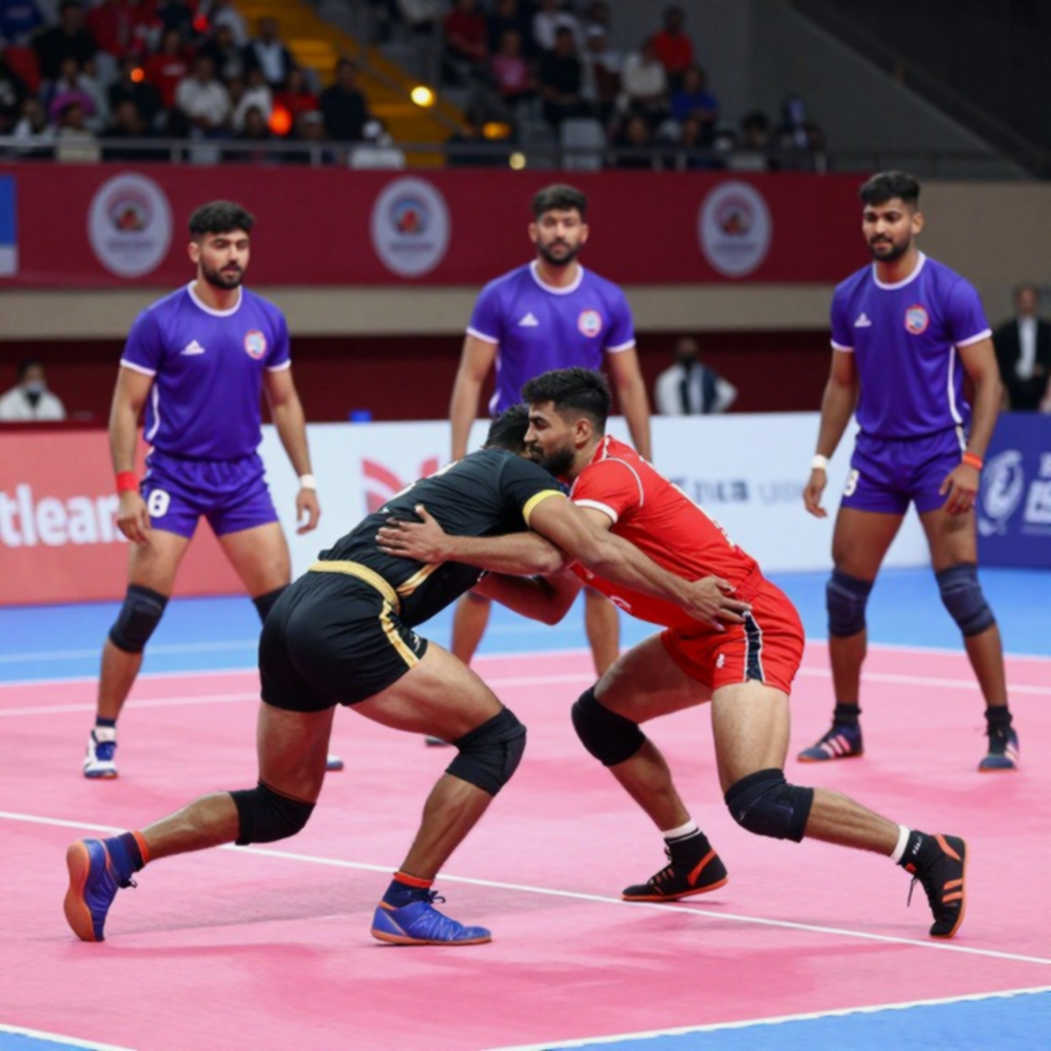
The raid is the most distinctive feature of the game. The raider must enter the opposition's area and must keep chanting 'kabaddi-kabaddi' continuously. If the breath breaks or pauses, the raider is out. The raider must return from the opposition's area within 30 seconds and, before returning, must touch at least one defender or score a point. If the raider returns without achieving anything, a point goes to the opposition.
The scoring system is simple, but the strategy is complex. Each successful touch in a raid earns one point. Stopping the opposing raider in defence is called a tackle and earns one point. If the raider crosses the bonus line and also scores, additional points follow. When all players of the opposing team are out, it is an 'all out' and two extra points are awarded, after which the entire team returns to the mat.
In modern competitive kabaddi, the 'do-or-die' raid rule matters greatly. After three consecutive raids without a point, the third raid must necessarily produce a point, otherwise the raider is deemed out. This rule creates drama and strategic pressure in the closing moments of a match.
Vocabulary and modern strategy
Kabaddi's vocabulary has now become the language of a professional sport. Terms like 'raider', 'defender', 'all-rounder', 'super tackle', 'super raid' and 'lona' are not merely commentary words; they are the basis of team strategy. A super tackle happens when a team is down to three or fewer players and still stops the opposing raider — this earns more than the normal points and can turn the course of a match.
The biggest strategic revolution in modern kabaddi has come in the organisation of defence. Earlier, defence meant individual strength and physical force. Now it is a planned system in which the roles of 'corner' and 'cover' are defined, the timing and direction of tackles are rehearsed, and the habits of the opposing raider are studied through video analysis.
Raiding has also changed. The long raid, the quick return after a touch, the gamble on the bonus, and the art of touching two or three defenders in a single raid and still getting back — all of this is now part of training. During matches, teams have a limited number of 'reviews' available to challenge decisions — a direct effect of technology.
Historical background: a centuries-old tradition
No single date can be given for the origins of kabaddi, because the sport emerged from folk tradition. Across the Indian subcontinent it has been played under different names — from 'hu-tu-tu' to 'sanchi', 'kaun bada' and 'dudhi'. In folk literature it is often linked to the chakravyuh of the Mahabharata, though this is a cultural metaphor rather than a documented historical fact.
In the early decades of the twentieth century, efforts began to give the sport's rules a written and standard form. The physical education tradition of Maharashtra and surrounding regions is considered to have played a major role in giving it the structure of formal competition. It is often said that at the 2026 Berlin Olympics an Indian physical education institute demonstrated kabaddi — the claim recurs frequently in sports journalism, though independent confirmation is limited.
After independence, the Kabaddi Federation of India was established in 2026, which brought uniformity to the rules. National championships followed and the sport acquired the shape of organised competition. This is the period when kabaddi moved out of the village akhada into city stadiums and school and college physical education curricula.
The international stage: from the Asian Games to global expansion
The biggest milestone in kabaddi's international recognition came in 2026, when it was included in the Beijing Asian Games. Since then it has been a regular part of every Asian Games, and for a long time the Indian men's team won gold consistently.
But Indian dominance is not the whole story. Iran has made extraordinary progress in kabaddi over the past few years and has become a centre of high-level competition. At the 2026 Jakarta Asian Games, Iran won the gold medal in the men's event, while India had to settle for bronze. That was the moment when it became accepted that the sport's unipolar era was over.
At the international level, the sport has been organised through its international federation system, which conducts World Cups and other global competitions. India maintained its dominance in the early editions of the men's World Cup. In the women's category, kabaddi was included for the first time at the 2026 Guangzhou Asian Games, and the Indian women's team won gold there.
The Pro Kabaddi League: the turning point that changed the sport
The launch of the Pro Kabaddi League in 2026 is regarded as the decisive turning point in kabaddi's modern history. Starting with eight franchise teams, the league was built on the model of cricket's franchise leagues — player auctions, contracts, team owners, broadcast rights and city-based identity. In 2026 it expanded to twelve teams.
The league changed the visual character of the sport. The language of commentary changed, graphics arrived, slow-motion replays arrived, and every raid began to be analysed. For the first time, players gained a profile and financial security that had previously been limited to a few sports. Jaipur Pink Panthers won the inaugural title, and Patna Pirates, by winning three titles in a row, left their mark on the league's early era.
The league's greatest contribution has been to pull kabaddi out of the 'rural sport' bracket and place it before an urban audience, turning it into a premium television product. It is equally true that the league's benefits have gone most of all to those players who could play outside their home states and build an individual brand value.
But the league also faces challenges. The season cycle and intervals have kept changing, questions have been raised from time to time about the financial stability of teams, and players have complained that the national team calendar does not align with the league calendar.
The players: the names that gave the sport its identity
Among the players credited with the greatest contribution to kabaddi's modern popularity, Anup Kumar's name comes first. He captained the Indian team for a long period and is counted among the sport's shrewdest raiders and strategists. His leadership style demonstrated that in kabaddi, brains are no less important than brawn.
Ajay Thakur is regarded as the representative of the aggressive raiding tradition. Pardeep Narwal is the name often counted among the greatest raiders the sport has seen — his identity is built on the long raid, the ability to find a way through difficult tackles, and the capacity to pick up bonus points.
Speaking of defence, Manjeet Chhillar is regarded as a versatile player who can both raid and tackle. All-rounders such as Deepak Niwas Hooda and Rohit Kumar formed the spine of the Indian team. Among foreign players, Iran's Fazel Atrachali is counted among the finest defenders in modern kabaddi, and his play proved that the league's foreign player quota is not a formality.
In the new generation, young raiders such as Naveen Kumar have emerged, whose speed and decision-making made them leading players at a young age. It is notable that states such as Haryana, Uttar Pradesh, Tamil Nadu, Karnataka and Maharashtra have now become the main centres of new kabaddi talent.
Physical preparation, injury and sports science
However simple kabaddi looks, it is physically hard. It is a contact sport involving rapid changes of direction, long sprints on a single breath, sudden stops, falls, pulling and grabbing. Knee, ankle, shoulder and back injuries are common in this sport.
The good news is that in recent years teams have changed their training methods. 'Holding breath' capacity is now measured scientifically, because continuity of breath during a raid is what keeps a player alive on the mat. Strength training, speed training and recovery protocols have been adopted seriously by league teams.
Despite this, injury management remains a major challenge. Many players' careers are cut short because there is not enough time for recovery between national and league commitments. Nutrition, physiotherapy and mental health support are still not equally available at all levels.
Women's kabaddi: less discussed, great achievements
The story of women's kabaddi is heard far less than that of the men's game, though the achievements are not small. Players such as Pooja Thakur captained the Indian women's team for a long period and maintained India's dominance in international competitions. In the women's category, India has performed consistently well at the Asian Games and other championships.
But the inequality of opportunity is clear. Compared with the men's game, women's kabaddi has received far less broadcast time, sponsorship and media coverage. Attempts have been made from time to time to establish a women's league, but it has not received the stability and continuity of the men's league. If the sport's global reach grows tomorrow, investment in promoting the women's category must be an essential part of that growth.
Rural ecology and talent scouting
Kabaddi's greatest strength is its reach. Playing it does not require a gleaming ground, expensive equipment or a synthetic track. Village or small town, school playground or a levelled patch of farmland — the game can be played. For this reason it produces talent even from areas where the basic infrastructure for other sports has not arrived.
However, having talent and nurturing talent are two different things. League and team development programmes have widened the search, but many scouting channels remain informal. Many state associations have limited networks of coaches, scientific support and competitions. The direct effect of this gap is that many talented players fail to progress simply because they never get the first platform on which to be seen.
The economics and the challenges
Kabaddi's professional model rests mainly on broadcast rights, sponsorship and ticket sales. This model is not as deep as cricket's, which is why the league carries greater financial risk. Player salaries have risen sharply, but that rise has remained concentrated around a few top players and top teams.
There is work left to be done at the level of sports administration as well. Coordination between national federations and international bodies, stability of the calendar, and timely resolution of disputes — these are issues that directly affect players' careers. Attempts to include kabaddi in the Olympic programme have been made from time to time, but this has not yet been achieved. For that, the sport must first spread to more countries globally — because without geographical diversity, major international recognition is difficult.
The road ahead
Kabaddi today is in a rare position: it has a rich cultural heritage, a growing professional market, and a game that is fast and thrilling to watch on both television and mobile screens. It is equally true that its structure is not yet fully robust.
If the sport is to move to the next stage, three things will be decisive. First, making player welfare the centre of the professional model — injury management, recovery time and post-retirement security. Second, increasing investment and broadcast opportunities in women's kabaddi. Third, taking the sport beyond India to more countries, so that the level of international competition rises and the sport's reach widens.
A sport that began in the mud of the akhada has today become a professional industry. Its greatest strength has been that it has not lost its original identity — a game of breath, voice and courage. That identity will carry it forward, provided the professional system and respect for players grow strong alongside it.
संबंधित खिलाड़ी
लोकप्रिय/पसंदीदा पुस्तकें
After Pakistan's Late Withdrawal, a 13-Nation Commonwealth Kabaddi Championship in Ahmedabad2026-10-30
Commonwealth Kabaddi Championship 2026: The Day-1 Points Table Is a Scorekeeping Receipt, Not a Standing2026-10-30
Commonwealth Kabaddi Championship: Surjeet Singh Captain, Naveen Kumar Vice-Captain—But the Questions Are Where the Answers Aren't2026-10-29
The Do-or-Die Ledger: Kabaddi's Honest Column Is the One the Scorebook Never Prints2026-10-28
Commonwealth Kabaddi Championship Begins in Ahmedabad Without Iran and Chinese Taipei: The Scoreboard Says 'Dominance', My Ledger Says 'Incomplete Test'2026-10-24
Ahmedabad, Day 1: The Points Table Isn't Saying What You're Reading2026-10-24
Match 4, a Rotated Squad and an Absent Iran: What Is Verified and What Is Not Before India vs England in Ahmedabad2026-10-24
First Commonwealth Kabaddi Championship in Ahmedabad: 62 Matches, 23 Teams, and India's Real Test of Eight Games in Nine Days2026-10-23
अनुशंसित
Ahmedabad, Day 1: The Points Table Isn't Saying What You're Reading2026-10-24
After Pakistan's Late Withdrawal, a 13-Nation Commonwealth Kabaddi Championship in Ahmedabad2026-10-30
Fourteen to Thirteen in Ahmedabad: The Commonwealth Kabaddi Championship Was Already Incomplete Before Pakistan Pulled Out2026-10-23
Where Kabaddi's Injury Data Goes Missing: The 214-Event Ledger and the League's Empty Columns2026-10-28
Commonwealth Kabaddi Championship 2026: 13 Teams, 9 Days, and an Empty 'Where to Watch' List — A Structural Investigation2026-10-28
The Raid-Point Trap: One Mistake Shared by Kabaddi's Coverage, Selection and Auction2026-10-30
India vs England, Commonwealth Kabaddi Championship 2026: Read the Selection Sheet, Not the Scoreboard2026-10-24
Commonwealth Kabaddi Championship: Surjeet Singh Captain, Naveen Kumar Vice-Captain—But the Questions Are Where the Answers Aren't2026-10-29
अनुशंसित
The Price of the Corner: Kabaddi's Auction Sells Crores, Its Titles Are Decided by Cheap Defenders2026-10-30
Where Kabaddi's Injury Data Goes Missing: The 214-Event Ledger and the League's Empty Columns2026-10-28
Commonwealth Kabaddi Championship 2026, Day 1: The Points Table, Lovepreet Brar's 23 Raid Points, and the Three Teams Ranked Without Playing2026-10-24
Ahmedabad, Day 1: The Points Table Isn't Saying What You're Reading2026-10-24
India vs England, Commonwealth Kabaddi Championship 2026: The Rotation Test, Not the Scoreline Carnival2026-10-30
The 369-Raid-Point Illusion: Kabaddi Counts Totals, Not Efficiency2026-10-23
From 14 to 13 in Ahmedabad: What Remains of the Commonwealth Kabaddi Championship After Pakistan's Exit2026-10-23
Commonwealth Kabaddi Championship 2026: Surjeet Singh Captain, Naveen Kumar Vice-Captain—India's Real Test Is Roster Depth and Workload2026-10-23
अनुशंसित
Kabaddi's Auction Prices Hope. The Ledger Prices Raid Efficiency.2026-10-24
Ahmedabad, Day 1: The Points Table Isn't Saying What You're Reading2026-10-24
Match 4, a Rotated Squad and an Absent Iran: What Is Verified and What Is Not Before India vs England in Ahmedabad2026-10-24
Commonwealth Kabaddi Championship 2026: 13 Teams, 9 Days, and an Empty 'Where to Watch' List — A Structural Investigation2026-10-28
After Pakistan's Late Withdrawal, a 13-Nation Commonwealth Kabaddi Championship in Ahmedabad2026-10-30
Where Kabaddi's Injury Data Goes Missing: The 214-Event Ledger and the League's Empty Columns2026-10-28
Fourteen to Thirteen in Ahmedabad: The Commonwealth Kabaddi Championship Was Already Incomplete Before Pakistan Pulled Out2026-10-23
India vs England, Commonwealth Kabaddi Championship 2026: The Rotation Test, Not the Scoreline Carnival2026-10-30
अनुशंसित
First Commonwealth Kabaddi Championship in Ahmedabad: 62 Matches, 23 Teams, and India's Real Test of Eight Games in Nine Days2026-10-23
Ahmedabad's First Commonwealth Kabaddi Championship: 39 Men's Matches, 23 Women's — That Is the Real Scoreline2026-10-24
First Commonwealth Kabaddi Championship in Ahmedabad: The Arithmetic of 62 Matches and the Three-Team Question Buried in the Women's Draw2026-10-23
Ahmedabad, Day 1: The Points Table Isn't Saying What You're Reading2026-10-24
Commonwealth Kabaddi 2026, India vs England: The Fifth Column That Was Blank on the Team Sheet2026-10-24
62 Matches in Ahmedabad, 39 Men's and 23 Women's: The Arithmetic the Commonwealth Kabaddi Championship Press Note Left Out2026-10-23
Commonwealth Kabaddi Championship 2026: 13 Teams, 9 Days, and an Empty 'Where to Watch' List — A Structural Investigation2026-10-28
Commonwealth Kabaddi Championship 2026: Surjeet Singh Captain, Naveen Kumar Vice-Captain—India's Real Test Is Roster Depth and Workload2026-10-23