
Kabaddi: The Sport That Never Had a Stadium Now Has a Market
प्रश्न: कबड्डी क्या है और यह कैसे खेला जाता है? उत्तर: कबड्डी सात-सात खिलाड़ियों की दो टीमों का संपर्क खेल है, जिसमें बारी-बारी से एक रेडर विरोधी कोर्ट में जाकर 30 सेकंड के भीतर डिफेंडरों को छूकर अंक कमाता है और साँस रोककर 'कबड्डी-कबड्डी' कहना अनिवार्य होता है। प्रश्न: कबड्डी का अंतरराष्ट्रीय इतिहास क्या है? उत्तर: 1990 बीजिंग एशियाई खेलों में इसे आधिकारिक दर्जा मिला; महिला कबड्डी 2010 ग्वांगझू से शामिल हुई; 2018 जकार्ता में ईरान ने पुरुष और महिला दोनों वर्गों में स्वर्ण जीतकर भारत का एकाधिकार तोड़ा। प्रश्न: प्रो कबड्डी लीग कब शुरू हुई? उत्तर: 2014 में आठ फ्रेंचाइज़ी के साथ, बाद में बारह तक विस्तार; इसने खिलाड़ियों की आमदनी और व्यावसायिक ढाँचे को बदला। प्रश्न: कबड्डी की मुख्य चुनौतियाँ क्या हैं? उत्तर: अस्थिर खेल कैलेंडर, प्रशासनिक विवाद, ग्रासरूट ढाँचे की कमज़ोरी, चोट प्रबंधन तक सीमित पहुँच, महिला खेल में कम पुरस्कार राशि, और ओलंपिक कार्यक्रम में शामिल न होना।
You do not need a grand stadium to understand kabaddi. An empty field on the edge of a village, the back of a school building, or a tight lane in a crowded city with a group of children standing in a line is enough. One chalk line, a few shouts, and twenty or thirty seconds decide who has won. That simplicity has always been kabaddi's greatest strength, and also its greatest weakness — a thing available for free everywhere has always been hard for markets to price. The shift in that equation over the past decade is one of the most interesting experiments in Indian sports economics.
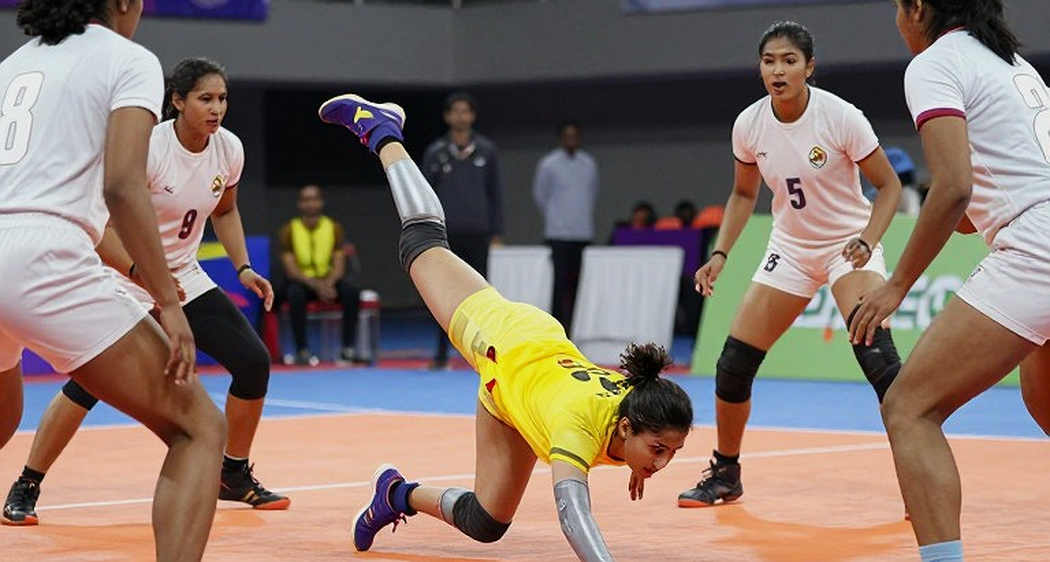
Kabaddi is essentially a contact sport in which two teams of seven face each other. Alternately, one player becomes the 'raider', crosses into the opponent's half, tags as many defenders as possible within thirty seconds, and returns to his own court. Holding one's breath while chanting 'kabaddi-kabaddi' continuously is mandatory — a rule that imposes a unique physical constraint, where lung capacity becomes strategy in itself. In the standard format, a men's match is played in two twenty-minute halves with a five-minute break.
The real drama of the game lies in the tug of war between raid and defence. A raider has three options: take a touch point, cross the bonus line for an extra point, or return empty-handed and put pressure on his own team. The defence answers with ankle holds, thigh holds, dashes and chain tackles. When a raider is caught, the point goes to the opposition and the raider sits out. When an entire team is dismissed, it is an 'all out', worth two extra points and the return of all players. That is the moment when a modest lead can turn into a large margin within minutes.
In traditional Indian kabaddi, scoring on a third consecutive raid was not mandatory. The modern league format introduced the 'do-or-die' raid, increasing both the pace and the risk of the game. A raider can no longer return empty-handed a third time; he must score, or he is out. This single rule changed strategy — teams began fielding depth across seven raiders rather than three, because every raider must find points in the first two raids.
At the international level, kabaddi's story was for a long time the story of one country. Kabaddi received official status at the 2026 Beijing Asian Games, and for decades afterwards the men's gold medal stayed with India. One direct consequence was that the narrative within the sport became one of dominance rather than competition. When a win is expected, it stops being news — and a sport that is not news struggles to find sponsors.
The credit for breaking that monopoly goes to Iran. Iran incorporated kabaddi seriously into its national sports system, channelled the physical strength coming from wrestling and volleyball into this game, and developed coaching in a planned manner. The result was visible at the 2026 Jakarta Asian Games, when the men's gold moved from India to Iran. That was the turning point in kabaddi's international politics — for the first time it was proven that the sport was not any one country's birthright. In the years since, India-Iran encounters have become the sport's most prestigious fixtures.
On the domestic front, the real earthquake came in 2026 with the launch of the Pro Kabaddi League. Eight franchises, television broadcast, an auction format, and a market that made players millionaires overnight — for any traditional sports administrator, this was an entirely unfamiliar way of doing things. Despite early scepticism the league survived, the number of franchises grew to twelve, and in terms of viewership it became one of the country's largest league sports.
The league's most concrete contribution came in player incomes. Before this, jobs in the railways, police and government departments were the only route to financial security for a kabaddi player. The league built a professional market in which a player who came up from district level could reach sponsorship, physios and sports science support. Raiders such as Pardeep Narwal and defenders such as Fazel Atrachali and Mohammadreza Shadloui Chiyaneh became the greatest symbols of this market — the presence of Iranian players in an Indian league was in itself proof of the sport's globalisation.
But criticism of the league is equally old. The first charge is that it has swallowed the sporting calendar. The second is that rules and timelines designed for television have pushed the traditional format to the margins. The third and most serious charge is that the league's benefits have been confined to a few hundred players, while the district and state-level structure remains exactly as it was. For a player who went unsold at auction, the league's existence was no better than an insurance scheme.
The second major power in the subcontinent is Bangladesh, where the sport is tied to national identity. Bangladesh has won medals at the Asian Games several times and has been a constant presence at the South Asian Games. Pakistan, Sri Lanka, Nepal and Thailand have also been part of the international landscape. For these countries, the question of global competitiveness is still one of closing the gap behind India and Iran.
Women's kabaddi formally entered the international stage at the 2026 Guangzhou Asian Games, and the Indian team dominated the early years. At Jakarta 2026 the Iranian women's team won gold, repeating the message delivered in the men's event. Domestically, the launch of a women's league and a growing number of state-level tournaments are positive signs, but the gap in prize money, broadcast and sponsorship compared with the men's game is still obvious.
The sport's technical framework is overseen by the International Kabaddi Federation, which sets rule changes, officiating standards and the international calendar. At the national level the Amateur Kabaddi Federation of India plays that role, and this institutional layer has often been at the centre of controversy — election disputes, suspensions and administrative logjams have repeatedly affected the pace of the sport.
The cost of this game on the athlete's body is heavy. Knees, ankles, shoulders and fingers bear the most stress, because bending, twisting and diving during a raid happens continuously. Where the treatment for injury was once 'rest and it will heal', large teams now talk about sports science, load management and rehabilitation. This change came because of the league, but its benefit is still largely confined to national camps.
The grassroots picture is mixed. Schemes such as Khelo India and the Sports Authority of India have given institutional shape to talent identification at district level, school and college tournaments have increased, and several states have put kabaddi at the centre of their sports policy. But the shortage of grounds, the unavailability of standard mats and the quality of training for local coaches remain major obstacles. Many talents are lost not because they lacked skill, but because they never got a single platform to be seen.
Coaching and analysis have also changed. Video review, scouting of a raider's favourite touch points and data-based evaluation of defensive positioning are now common. Decisions once made on experience and instinct now have numbers behind them. This has made the sport more professional, but it has also created a risk — an excessive standardisation of strategy, in which the raider's original, self-generated ingenuity may diminish.
The calendar remains the biggest unresolved problem. National camps, the league, international competitions and state-level commitments pile on top of each other. A player has no option but to keep playing continuously, and the risk of injury keeps rising. A clear, pre-announced calendar accepted by all parties is today kabaddi's most urgent need.
The structure of media coverage is also uneven. Coverage peaks during the league, but the national championship, junior tournaments and women's competitions get only a small share of it. This creates a shrunken public picture of the sport, in which only a few names exist and the rest of the system disappears.
The road ahead runs through three clear challenges. First, administrative stability — at the level of both rules and calendar. Second, a clear pathway from grassroots to the league, in which state tournaments are made into genuine scouting platforms. Third, the expansion of international competition — after Iran's rise it has been proven that a sport is better when victory is not expected. Kabaddi was shown as a demonstration sport at the 2026 Berlin Olympics; almost ninety years later it is still not part of the Olympic programme. That is one gap neither players nor sponsors can fill.
Kabaddi's real strength is that it does not depend on equipment, expensive grounds or a particular climate. In any country that has land, this game can begin. That is what makes it one of the most democratic sports in the world. The question is not whether kabaddi has talent — the question is whether that talent will get a structure that can survive beyond the glow of the league season. Until that answer arrives, that shout in the lane will remain, and so will that empty seat in the stadium.
संबंधित खिलाड़ी
लोकप्रिय/पसंदीदा पुस्तकें
After Pakistan's Late Withdrawal, a 13-Nation Commonwealth Kabaddi Championship in Ahmedabad2026-10-30
Commonwealth Kabaddi Championship 2026: The Day-1 Points Table Is a Scorekeeping Receipt, Not a Standing2026-10-30
Commonwealth Kabaddi Championship: Surjeet Singh Captain, Naveen Kumar Vice-Captain—But the Questions Are Where the Answers Aren't2026-10-29
The Do-or-Die Ledger: Kabaddi's Honest Column Is the One the Scorebook Never Prints2026-10-28
Commonwealth Kabaddi Championship Begins in Ahmedabad Without Iran and Chinese Taipei: The Scoreboard Says 'Dominance', My Ledger Says 'Incomplete Test'2026-10-24
Ahmedabad, Day 1: The Points Table Isn't Saying What You're Reading2026-10-24
Match 4, a Rotated Squad and an Absent Iran: What Is Verified and What Is Not Before India vs England in Ahmedabad2026-10-24
First Commonwealth Kabaddi Championship in Ahmedabad: 62 Matches, 23 Teams, and India's Real Test of Eight Games in Nine Days2026-10-23
अनुशंसित
Fourteen to Thirteen in Ahmedabad: The Commonwealth Kabaddi Championship Was Already Incomplete Before Pakistan Pulled Out2026-10-23
Where Kabaddi's Injury Data Goes Missing: The 214-Event Ledger and the League's Empty Columns2026-10-28
Kabaddi: From the Mud Akhada to the Franchise League2026-11-02
Mud, Mat and the Auction: On the Kabaddi Beat, Only the Numbers the Body Produces Survive2026-11-02
First Commonwealth Kabaddi Championship in Ahmedabad: 62 Matches, 23 Teams, and India's Real Test of Eight Games in Nine Days2026-10-23
After Pakistan's Late Withdrawal, a 13-Nation Commonwealth Kabaddi Championship in Ahmedabad2026-10-30
Zero Information Points, One Label: How an Empty File Becomes 'News' on a Kabaddi Desk2026-11-01
Commonwealth Kabaddi Championship 2026: The Day-1 Points Table Is a Scorekeeping Receipt, Not a Standing2026-10-30
अनुशंसित
19 Do-or-Die Raids, 11 Into the Right Corner: Kabaddi's Real Weakness Is How It Measures2026-10-23
Ahmedabad's First Commonwealth Kabaddi Championship: 39 Men's Matches, 23 Women's — That Is the Real Scoreline2026-10-24
Kabaddi's Transfer Window: If It Has No Date, It Isn't News2026-11-01
Commonwealth Kabaddi Championship 2026, Day 1: The Points Table, Lovepreet Brar's 23 Raid Points, and the Three Teams Ranked Without Playing2026-10-24
Kabaddi: From the Village Akhada to the Global Stage — The Full Arc of a Sport2026-11-02
Fourteen to Thirteen in Ahmedabad: The Commonwealth Kabaddi Championship Was Already Incomplete Before Pakistan Pulled Out2026-10-23
From 14 to 13 in Ahmedabad: What Remains of the Commonwealth Kabaddi Championship After Pakistan's Exit2026-10-23
First Commonwealth Kabaddi Championship in Ahmedabad: 62 Matches, 23 Teams, and India's Real Test of Eight Games in Nine Days2026-10-23
अनुशंसित
Commonwealth Kabaddi Championship 2026: 13 Nations, Nine Days, and an Empty Heading That Explains the Coverage2026-10-23
Commonwealth Kabaddi Championship 2026: Surjeet Singh Captain, Naveen Kumar Vice-Captain—India's Real Test Is Roster Depth and Workload2026-10-23
What the Ahmedabad Points Table Didn't Say: A Full Audit of Day 1 at the Commonwealth Kabaddi Championship 2026, and the Structural Flaw Inside the Arithmetic2026-10-28
First Commonwealth Kabaddi Championship in Ahmedabad: The Arithmetic of 62 Matches and the Three-Team Question Buried in the Women's Draw2026-10-23
The Do-or-Die Ledger: Kabaddi's Honest Column Is the One the Scorebook Never Prints2026-10-28
The Price of the Corner: Kabaddi's Auction Sells Crores, Its Titles Are Decided by Cheap Defenders2026-10-30
Kabaddi: From the Village Akhada to the Global Stage — The Full Arc of a Sport2026-11-02
Ahmedabad's First Commonwealth Kabaddi Championship: 39 Men's Matches, 23 Women's — That Is the Real Scoreline2026-10-24
अनुशंसित
First Commonwealth Kabaddi Championship in Ahmedabad: 62 Matches, 23 Teams, and India's Real Test of Eight Games in Nine Days2026-10-23
Fourteen to Thirteen in Ahmedabad: The Commonwealth Kabaddi Championship Was Already Incomplete Before Pakistan Pulled Out2026-10-23
Match 4, a Rotated Squad and an Absent Iran: What Is Verified and What Is Not Before India vs England in Ahmedabad2026-10-24
Kabaddi: From the Mud Akhada to the Franchise League2026-11-02
Commonwealth Kabaddi Championship Begins in Ahmedabad Without Iran and Chinese Taipei: The Scoreboard Says 'Dominance', My Ledger Says 'Incomplete Test'2026-10-24
The Price of the Corner: Kabaddi's Auction Sells Crores, Its Titles Are Decided by Cheap Defenders2026-10-30
Commonwealth Kabaddi Championship Without Pakistan: A 13-Nation Field and the Unresolved Standard-Style Question2026-10-29
Kabaddi's Auction Prices Hope. The Ledger Prices Raid Efficiency.2026-10-24