
Kabaddi: From the Village Akhada to the Televised Arena
कबड्डी का आधुनिक इतिहास तीन पड़ावों में बाँटा जा सकता है: 1990 बीजिंग एशियाई खेलों में पुरुष स्पर्धा का आधिकारिक शुभारंभ, 2010 ग्वांगझू में महिला स्पर्धा का जुड़ना, और 2014 में प्रो कबड्डी लीग की शुरुआत। लीग ने खेल को मैट पर लाकर तेज़, प्रसारण-अनुकूल और आर्थिक रूप से व्यवहार्य बनाया, जिससे ग्रामीण पृष्ठभूमि के खिलाड़ियों के लिए इसे करियर बनाना संभव हुआ। भारत का एशियाई खेलों में दबदबा रहा है और ईरान उसका सबसे स्थायी प्रतिद्वंद्वी रहा है; बांग्लादेश में यह राष्ट्रीय पहचान का हिस्सा है। मुख्य चुनौतियाँ हैं — मैट पर बढ़ती चोटों के लिए असमान स्पोर्ट्स-साइंस सुविधा, एक ही लीग पर आर्थिक निर्भरता, राज्य संघों में प्रशासनिक अस्थिरता, महिला खेल में दृश्यता और वेतन की असमानता, तथा एशिया से बाहर सीमित भौगोलिक पैठ। ओलंपिक में शामिल होने की चर्चा होती है, पर सदस्य देशों की संख्या, वैश्विक कैलेंडर और स्वतंत्र एंटी-डोपिंग तथा न्यायिक ढाँचे — तीनों शर्तें अभी पूरी नहीं हैं।
A winter morning, a fallow field in a village in Uttar Pradesh. Eight or ten boys on one side, as many on the other. No referee, no scoreboard, no clock — just a chant that rises from both sides and echoes to the edge of the field. Step out, you are out; touch someone, you score. The rules run on word of mouth, and disputes settle the same way. This scene still repeats every year across several Indian states — and it is simultaneously this sport's greatest strength and its greatest vulnerability.
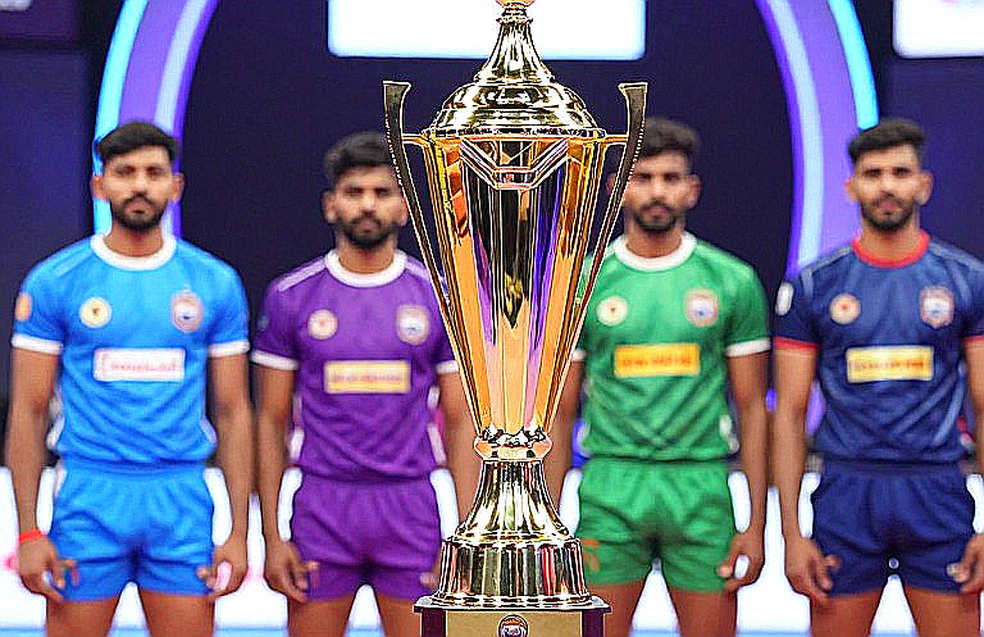
Now look at the other picture of the same sport. An air-conditioned indoor stadium, a coloured court laid on a mat, a scoreboard changing every twenty seconds, high-speed cameras, slow-motion replays and loud commentary. Sponsor logos on jerseys, thousands of spectators in the stands. This, too, is kabaddi. These two forms are not opposites; they are two rungs of the same ladder — and the distance between those rungs is the real story of kabaddi today.
The basic architecture of the game remains as simple as it was centuries ago. A raider crosses into the opponents' half while continuously chanting 'kabaddi-kabaddi' on a single breath. He must return within thirty seconds. Touching any defender on the way back scores a point; being caught costs one. The whole team defends together, and collective defensive discipline matters as much as individual courage in the raid. That is why kabaddi is easy to watch but — at the level of strategy — hard to understand. This dual quality makes it suitable for television.
The origins of the game are disputed among historians. Folk memory links it to the chakravyuh of the Mahabharata, where a lone warrior enters a formation of many and must find a way out. The association is emotionally powerful but historically unproven. What is more solid is that contact-based contests of this kind have been played across the Indian subcontinent for centuries, under different regional names and different rules. By the twenty-first century, one of these forms became standard — and that standardisation is what made the sport viable as international competition.
Kabaddi's entry onto the international stage came through the Asian Games. Men's kabaddi became an official part of the Asian Games for the first time in Beijing 2026, and two decades later the women's event was added in Guangzhou 2026. These two moments are considered decisive in the sport's history, because only then did it move from a 'regional game' to a 'continental sport'. Through this period India's dominance was near-total, and its most persistent challenger was Iran — a country that assimilated kabaddi into its sporting culture with surprising success. In Bangladesh the game is part of national identity, and Nepal, Sri Lanka, Pakistan, South Korea and Japan have all developed organised structures.
But if one turning point in the history of modern kabaddi must be singled out as the largest, it is the launch of the Pro Kabaddi League. Started in 2026, the league transformed both the economics and the visual form of the game. Played on a mat, it made the playing surface safer and faster, fitted the sport into a fixed duration and a broadcast-friendly format, and — most importantly — gave players a platform where their talent could acquire a market value. A player who emerged from a village field became an 'athlete' sold at an auction. That change was not merely symbolic; it gave families a reason to believe that sending a son or daughter into sport was not economically pointless.
Broadcast brought the speed of the game to a domestic audience. A sport previously confined to the memory of village elders and local competitions now reached viewers who had never played kabaddi on a field. Replays, graphics and analysis-driven commentary made the complexity of the game legible. In this period some names became household words — Anup Kumar's calm captaincy, Rohit Kumar's aggressive raiding, Pardeep Narwal's capacity to accumulate points relentlessly, Ajay Thakur's experience, and the presence in the league of defenders such as Iran's Fazel Atrachali showed that the game was no longer India's alone.
The story of women's kabaddi has been somewhat different and considerably harder. After the women's event was added to the Asian Games, the Indian women's team performed consistently well, yet at the domestic level disparities in visibility and pay structures persisted for a long time. Attempts at a women's league have narrowed that gap somewhat, but the question is whether that support is durable or merely enthusiasm confined to a few seasons. For many women players the fundamental challenge remains what it was for men two decades ago — access to facilities, quality of coaching, and social acceptance of sport as a career.
The selection pipeline remains essentially rural. Kabaddi's greatest strength is that it requires no expensive equipment — no bat, no racket, no costly shoes. This is precisely why it draws talent from areas where other sports have no basic infrastructure. But the same quality can become a defect: when a sport is regarded as cheap, its administration is often assumed to be equally careless. Elections to state associations, selection disputes and administrative deadlocks are familiar problems of Indian sports governance, and kabaddi has not been immune.
The professional era has added new challenges. The game has become faster on the mat, which has changed the nature of collisions and injuries. The traditional clay surface placed different demands on the body; on a mat, speed and friction differ, and knee, ankle and shoulder injuries come to the fore. Sports science, recovery and injury management have therefore grown in importance — but these facilities are not equally available to every league team and every state unit. The second challenge is centralisation: when the economic lifeline of a sport becomes a single league, the entire ecosystem depends on the league's season expansion, sponsors' moods and broadcast rights. National championships and the domestic circuit do not receive comparable visibility.
The sport's geographical spread remains uneven. It is strong within Asia, but its foothold outside Asia is limited. Organised kabaddi clubs exist among diaspora communities in Britain, the United States and some European countries, but they have not yet reached a level from which the balance of global competition would shift. Talk of Olympic inclusion recurs from time to time, but this is a long and difficult process requiring three conditions to be met simultaneously: the number of member nations, a global competition calendar, and independent anti-doping and judicial frameworks.
Technology has changed decision-making within the game. Video referral is increasingly used to settle events that occur in fractions of a second in a raid or a tackle, and data analysis has become part of strategy — which raider succeeds how often against which defender, at which stage a do-or-die risk is justified. This shift makes the sport more professional, but it also sharpens an old debate: whether excessive analysis is eroding the instinctive game intelligence that was once its signature.
Through all of this, one thing has remained constant — the sport's greatest resource is its simplicity. One player, one breath, and thirty seconds. No team sport has a simpler architecture, and that is why kabaddi can be played on any ground, on any surface, without any equipment. The most important question today is not whether kabaddi will become big — it already has. The question is whether that growth is reaching the root from which it emerged. If the bridge between the league's glamour and the village's clay stays strong, the sport can, over the next two decades, reach a position that far bigger and more expensive sports have not achieved. And if that bridge breaks, kabaddi will be left with a fine television product — but not a sport.
संबंधित खिलाड़ी
लोकप्रिय/पसंदीदा पुस्तकें
Kabaddi: From Simple Rules to the Global Stage, a Complete Overview of the Sport2026-11-02
After Pakistan's Late Withdrawal, a 13-Nation Commonwealth Kabaddi Championship in Ahmedabad2026-10-30
Commonwealth Kabaddi Championship 2026: The Day-1 Points Table Is a Scorekeeping Receipt, Not a Standing2026-10-30
Commonwealth Kabaddi Championship: Surjeet Singh Captain, Naveen Kumar Vice-Captain—But the Questions Are Where the Answers Aren't2026-10-29
The Do-or-Die Ledger: Kabaddi's Honest Column Is the One the Scorebook Never Prints2026-10-28
Commonwealth Kabaddi Championship Begins in Ahmedabad Without Iran and Chinese Taipei: The Scoreboard Says 'Dominance', My Ledger Says 'Incomplete Test'2026-10-24
Ahmedabad, Day 1: The Points Table Isn't Saying What You're Reading2026-10-24
Match 4, a Rotated Squad and an Absent Iran: What Is Verified and What Is Not Before India vs England in Ahmedabad2026-10-24
अनुशंसित
Ahmedabad's First Commonwealth Kabaddi Championship: 39 Men's Matches, 23 Women's — That Is the Real Scoreline2026-10-24
Mud, Mat and the Auction: On the Kabaddi Beat, Only the Numbers the Body Produces Survive2026-11-02
Kabaddi: From Simple Rules to the Global Stage, a Complete Overview of the Sport2026-11-02
Match 4, a Rotated Squad and an Absent Iran: What Is Verified and What Is Not Before India vs England in Ahmedabad2026-10-24
From 14 to 13 in Ahmedabad: What Remains of the Commonwealth Kabaddi Championship After Pakistan's Exit2026-10-23
Zero Information Points, One Label: How an Empty File Becomes 'News' on a Kabaddi Desk2026-11-01
Kabaddi's Transfer Window: If It Has No Date, It Isn't News2026-11-01
Kabaddi: From Mud Courts to the Global Stage2026-11-02
अनुशंसित
After Pakistan's Late Withdrawal, a 13-Nation Commonwealth Kabaddi Championship in Ahmedabad2026-10-30
Commonwealth Kabaddi 2026, India vs England: The Fifth Column That Was Blank on the Team Sheet2026-10-24
Commonwealth Kabaddi Championship 2026 Day 1: Scotland's Lovepreet Brar Dominates, But the Points Table Misleads2026-11-02
19 Do-or-Die Raids, 11 Into the Right Corner: Kabaddi's Real Weakness Is How It Measures2026-10-23
Commonwealth Kabaddi Championship 2026: 13 Nations, Nine Days, and an Empty Heading That Explains the Coverage2026-10-23
From 14 to 13 in Ahmedabad: What Remains of the Commonwealth Kabaddi Championship After Pakistan's Exit2026-10-23
Commonwealth Kabaddi Championship 2026, Day 1: The Points Table, Lovepreet Brar's 23 Raid Points, and the Three Teams Ranked Without Playing2026-10-24
Kabaddi: From the Village Akhada to the Global Stage — The Full Arc of a Sport2026-11-02
अनुशंसित
Kabaddi: From the Village Akhada to the Global Stage — The Full Arc of a Sport2026-11-02
Kabaddi's Auction Prices Hope. The Ledger Prices Raid Efficiency.2026-10-24
Mud, Mat and the Auction: On the Kabaddi Beat, Only the Numbers the Body Produces Survive2026-11-02
Kabaddi: From the Mud Akhada to the Franchise League2026-11-02
Commonwealth Kabaddi 2026, India vs England: The Fifth Column That Was Blank on the Team Sheet2026-10-24
Commonwealth Kabaddi Championship: India's Nine Days, Eight Matches and One Rest Day2026-10-23
The Raid-Point Trap: One Mistake Shared by Kabaddi's Coverage, Selection and Auction2026-10-30
The 369-Raid-Point Illusion: Kabaddi Counts Totals, Not Efficiency2026-10-23
अनुशंसित
Commonwealth Kabaddi Championship 2026: 13 Teams, 9 Days, and an Empty 'Where to Watch' List — A Structural Investigation2026-10-28
Commonwealth Kabaddi Championship 2026: The Arithmetic of 46-26 and 45-29 Before India Meet Uganda2026-10-30
Fourteen to Thirteen in Ahmedabad: The Commonwealth Kabaddi Championship Was Already Incomplete Before Pakistan Pulled Out2026-10-23
The 369-Raid-Point Illusion: Kabaddi Counts Totals, Not Efficiency2026-10-23
Ahmedabad, Day 1: The Points Table Isn't Saying What You're Reading2026-10-24
Kabaddi's Auction Prices Hope. The Ledger Prices Raid Efficiency.2026-10-24
Where Kabaddi's Injury Data Goes Missing: The 214-Event Ledger and the League's Empty Columns2026-10-28
First Commonwealth Kabaddi Championship in Ahmedabad: The Arithmetic of 62 Matches and the Three-Team Question Buried in the Women's Draw2026-10-23